In this article from the New York Times, it is basically saying that because of today's economy, studies in humanities is seen as impractical because it concentrates on personal development, intellectualism, and forward-thinking. It doesn't prepare one for an actual job, like say engineering or medicine would.
At the end, the article says that humanities studies will soon be like it once was at the beginning of the 20th century: something only the wealthy priveleged will study.
This article is horrendously bleak. True: humanities studies do not prepare an individual specifically for an actual job in our society--a capitalist-based society where production and profit are valued. True: humanities is art--which never equals money in the pocket. True: humanities studies has no guarantees.
I call bullshit on the conclusion of the article: that only the wealthy priveleged will be the ones studying humanities. First of all, because of the huge surge in the middle class, and the blurring of the class divisions, we have, in America, rags-to-riches stories. Anyone can work from the bottom to the top if they so desire. Someone who has a degree in humanities, if they push themselves hard enough can become successful. It's the individual's responsibility to align themselves with success--if they so desire. Maybe some humanities students wouldn't mind living in a tool shed, surrounded by their philosophies, candles, and a crusty loaf of bread, so long as they have their books. You can't speak for every individual.
Secondly, even if (and this article smacks of dystopia for me) the humanities and liberal arts education were abolished and kept only for the rich--what kind of world do you envision? Something like in the film, Metropolis--workers, workers, and more workers? Orwellian dystopia? Ray Bradbury's Fahrenheit 451 where books are burned? No creativity? No imagination? Stifled words. Our current president is an individualist, free-thinking, forward-thinking man.
I am simply saying that the outcome of humanities studies will not just be for the wealthy. It's not entirely impractical, but you will learn more about yourself and you will craft an identity through your knowledge. Everyone is a humanist at heart, anyhow. We are not unfeeling robots. I do not fear the death of humanities.
As technology and the means of production increase and evolve, modern society now has greater access to everything. From pornography to exclusive art galleries, grape juice to vintage wine and everything in between is available at our disposal. Directly due to the advancement in quicker communication and discoveries in scientific research, mass production enables us to have all the commodities we need. Does all this easy access come at a price? In exploring the novel, Fahrenheit 451, by Ray Bradbury, and other texts and films, it is apparent that having things quickly and easily affect the way people feel, act, and think.
First, how and when did the western world become so heavily based on the assembly line process and mass production? Henry Ford revolutionized this means of production for his line of automobiles in the early twentieth century (Batchelor). Ever since then, we have utilized this in America to produce the majority of our goods. Nowadays, we outsource many of the factory jobs to other countries. Generally, this cheap means of labor means that we, as consumers, pay less and are happy with a bargain. However, on the other side, the worker suffers. Unfair wages or long work days contribute to a worker’s overall dissatisfaction. An early example of this would be the Triangle Shirtwaist Factory incident, where the working women were locked in the building, and a large majority died tragically.
A stunning example in film of the effect that this type of labor has on people is seen in Fritz Lang’s masterpiece, Metropolis. In a clip from the film, we see the workers carrying on with their jobs—making repetitive movements and are almost robotic. Perhaps what Lang is trying to criticize here is the near-tyranny of capitalism and how greed can affect the average person. Also in this clip, the robotic and unchanging movements serve to show how this type of environment and lifestyle can deplete a sense of self, or a sense of humanity. These people have become shells; just human bodies that simply function.
In Bradbury’s Fahrenheit 451, we see exactly this—people are shallow shells that function only on a surface level. They have no substance, no drive, no ambition, no yearning. Intellectual pursuits are forbidden, even. The protagonist, Guy Montag, is a firefighter, whose job is to burn all the books that he and his fellow firefighters find (58). This is what firefighters do in the world of Fahrenheit 451. They are not the heroes people usually associate them as, but as mediators of the so-called peace and sanctity of the culture. Montag then meets people that change his mind about the life he’s living and the world around him. He starts questioning everything. He is having a personal quest to find the truth. It is interesting that he finds dissatisfaction with his life. Chief Beatty is Montag’s superior at the fire station, and he says bluntly:
People want to be happy, isn’t that right? Haven’t you heard it all your life? I want to be happy, people say. Well, aren’t they? Don’t we keep them moving, don’t we give them fun? That’s all we live for, isn’t it? For pleasure, for titillation? And you must admit our culture provides plenty of these. (59)
Essentially, Beatty means that the fireman’s job is mass production. Burn the books, abolish philosophy, complicated thought, and reason because it doesn’t make people happy. If one person knows more than the other, they are not on equal playing ground, which is discouraging for the lesser.
Mass production, in this case loosely defined as making something rapidly and efficiently for all to consume. Philosopher Theodor Adorno, comments about mass production in relation to art: “The stunting of the mass-media consumer’s powers of imagination and spontaneity does not have to be traced back to any psychological mechanisms; he must ascribe the loss of those attributes to the objective nature of the products themselves.” If we are given poor quality entertainment or taught with a lack of substance or intelligence, then our imagination and creativity suffer. In Fahrenheit 451, the mass production of happiness and equality tries to permeate in all aspects of life. People now want instant gratification. This comes in the form of abbreviated television shows, movies, known as “parlor” television or family (Bradbury 82) and pills for sleeping, waking up, and every ailment in between (Bradbury 43).
There is a memorable scene in the film version of Fahrenheit 451 where Montag’s wife, Linda (Mildred in the novel), overdoses on her pills. Montag is distressed and tries to call for emergency help. The emergency line answers nonchalantly, asking him what color the pills are. They come in simple colors like white, blue, and yellow. Then two technicians come to Montag’s house and pump her blood with a machine, which will revive her and they simply shrug it off as routine procedure. What is interesting is how simple the pills are—basic colors—and a doctor does not come to check on Linda. The technology is simultaneously advanced and primitive. Everything is done at a fast pace. Interestingly, why does Linda feel compelled to take so many pills if everyone’s lives are meant to be happy? This is far from a picture of happiness.
Book-burning is the cornerstone of Bradbury’s novel. To burn books is to burn thought, ideas, imagination, creativity, inequality, and suppress revolution. Beatty says that books encourage inequality because, “Bigger the population, the more minorities. Don’t step on the toes of the dog lovers, the cat lovers, doctors, lawyers, merchants, chiefs, Mormons, Baptists, Unitarians, second-generation Chinese, Swedes, Italians, Germans, Texans, Brooklynites Irishmen, people from Oregon or Mexico” (Bradbury 57). This is all in hope that equality will mean contentment for all. However, the scene where Montag and the firemen burn a woman with her books is an example of how much they affect people. She is so attached to her books; she is willing to die with them. She strikes the match herself and the entire house ignites around her. (Bradbury 36-40) The old woman finds her happiness, not in the parlor television screens, or in simple entertainment, but from her books. She rejects her own society. This is echoed here: “The culture industry did away with yesterday’s rubbish by its own perfection, and by forbidding and domesticating the amateurish, although it constantly allows gross blunders without which the standard of the exalted style cannot be perceived” (Adorno & Horkheimer). Therefore mass production borrows from its former elements and churns out low-quality results for all to consume. This explains the old woman’s attachment to her books, her need for something deeper and meaningful, and Montag’s disillusionment with society.
Something I have increasingly noticed in our society, when I observe my family and friends is that there is such a reliance on technology. We are a culture that feasts on gadgets that help to make our lives easier, for example the iPhone or the Blackberry. Time and time again, I have heard people say “what I wouldn’t give to have one of those iPhones right now…I’m so bored!” It makes me wonder, a little nostalgically, what did people do before iPhones and Blackberries? Why do people camp out overnight to buy the newest video game console? Why do people get trampled to death in Wal-Mart because of this overzealous fascination with material things? Is it the “stuff” that makes a person this way, or are we, as people, truly this greedy and lustful? Where does this drive to want more and more things come from--ourselves or what the media portrays? Companies produce to make money, as evidenced in the assembly line formation: fast, efficient, cost-effective. It is an interesting dynamic between producer and consumer, a continuing cycle.
Today, mass production is meant to deliver the things used every day to people in the fastest way possible. The assembly line and the quick communication are optimal for saving time and money. However, it is apparent that mass production of happiness or art, things that are abstract or ambiguous suffer from the exchange. Ray Bradbury’s novel, Fahrenheit 451, gives a glimpse into a society where everything is instant and devoid of thought and imagination. The philosophies of this world have good intentions: to create equality for all. However, equality does not automatically translate to happiness or satisfaction. Rather, the people are vapid, find nothing meaningful, and in the case of Montag, are on a search for fulfillment but never seems satisfied. One cannot produce results or happiness with the flick of a switch or by popping a pill. It comes from within—from a functioning mind.
WORKS CITED
Adorno, Theodor and Horkheimer, Max. “The Culture Industry: Enlightenment as Mass Deception.” Dialectic of Enlightenment, 1994. CSUN WebCT.
Batchelor, Ray. Henry Ford, Mass Production, Modernism, and Design. Manchester: Manchester University Press, 1994.
Bradbury, Ray. Fahrenheit 451. New York: Ballantine, 1953.
Fahrenheit 451. Dir. François Truffaut. Perfs. Julie Christie, Oskar Werner, Cyril Cusack. Universal Pictures, 1966.
Metropolis. Dir. Fritz Lang. Perfs. Alfred Abel, Brigitte Helm, Gustav Frölich, Rudolf Klein-Rogge. Paramount Pictures, 1927.
In her home state of Alaska, a pardon was passed for the turkeys this Thanksgiving and Gov. Sarah Palin was stopped for an interview, gleaming brightly with a Burberry scarf wrapped around her neck.
You know, I love all things Palin (sense the tone) and this is just so irresistibly ironic, I had to share. :-|
Prof. asked us today in ENGL 312, opening our discussion on Ray Bradbury's novel Fahrenheit 451, “why books?” Why burn the books? If we go back about two centuries in our history, remember that during slavery, slaves were kept illiterate to keep them ignorant, because literacy = power. The power to read gives one the power to attain knowledge. Burning books, as is the case in the dystopic world of Fahrenheit 451 is a way to keep people ignorant and free of thought.
I’ve always loved to read. As a young child, it helped me to foster a very keen and vivid imagination. I questioned everything around me, because books, specifically works of literature take you to a world that is beyond your own. Captain Beatty, a character in the novel, says “Books say nothing! Nothing that you can teach or believe. They’re about nonexistent people, figments of imagination, if they’re fiction” (Bradbury 62). As an aspiring writer, that line stopped me dead in my tracks. A life without imagination? That’s no life to lead.
The novel examines this same line of thinking. For example, there are no porches because people sit out on porches to think. This “big brother” figure, the government, whoever does not want people to sit and think, to brood, or to ponder. It’s all a scheme to keep people in their place. That smells of totalitarianism. What a sad, sad world.
I saw a connection between the two films we have watched in class: more recently A Clockwork Orange and American Psycho. I saw them both as an allegory, a “what-if,” when people become disillusioned with society and find some sort of outlet to act upon their estrangement. The similarities between these two films are striking. Both Alex from Clockwork and Patrick Bateman from American Psycho have a taste for something finer than what they already have. I think that they were both searching and searching for something but they just didn’t know what it was. They were both fed up with everyone around them and acted out. Homicide and rape, complete disregard for human life. The films were chilling and put me in a state of unease. It made me fear the future because we already live in a society where many people are quite disillusioned with the government, economy, standards of living, and etc. It’s unsettling what the disorganized mess can do to affect others.
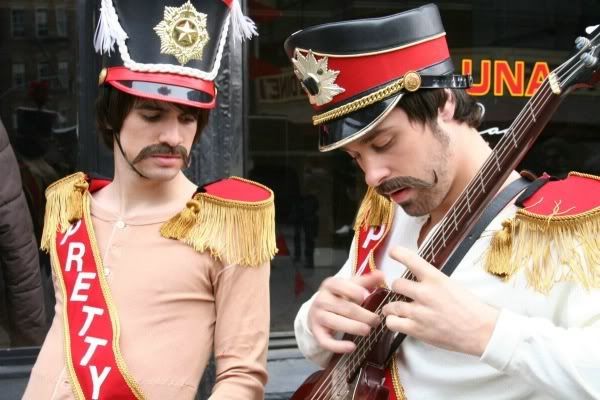
What I find interesting about A Clockwork Orange (and possibly American Psycho, as well) is that the movie and its characters are now fad or trendy. It’s the “cool thing” to like Clockwork and to even look and dress like Alex. In fact, there is one particular rock band that comes to mind and they are very popular. They are called Panic At The Disco and their look earlier in their career quite resembled the gang of Clockwork.
My point is that films like these have such tremendous cultural impact that I fear they will lose their novelty and people may become desensitized to the true meaning behind the films. That screams dystopic to me!
(Now they’re ripping off Beatles and the Sgt. Pepper era, but I won’t get too far into that).
Feel free to combat me on this issue. And I am not ripping on Panic! I actually enjoy their music and their look. I'd dress like them were I a dude. And gay. :D
Here's another good dystopic observation. Campus was closed today, due to the fires in Porter Ranch. I am wishing for everyone's safety out there, by the way!
Well I noticed that there was something eerie in the air, and I don't mean the smoke and ash floating around. Everyone had a solemn look, and walked like zombies. Weather-beaten and exhausted, it was just another manic Monday, right?
I noticed things were extra fishy when my broccoli cheese soup from Subway just didn't taste right. Then there seemed to be plenty of parking in the parking structures. This was very odd behavior, indeed!
Then hallways were empty. At 1:45, the hallways of Jerome Richfield are never empty.
I went to my professor's office and she said that the entire campus was closed. No classes today.
No classes?! You mean I drove all that way, worked my ass off this whole weekend to get everything done by Monday, and...classes are cancelled?
So I fled! I fled campus and people were driving worse than normal. Intersections were blocked. Ambulances and fire trucks blasted through the lanes, weaving in and out of the way. I got on the freeway. And here was something that I had never seen before.
Traffic was backed up horribly on the 118 West. I literally saw cars pull over to the right and drive in reverse to the next exit, Balboa Blvd. It was like synchronized driving; all the cars in one line at the same speed backing up to Balboa Blvd. It was surely a sight to see!
This was chaos. This was dystopia in action. This is what happens to people in these bizarre moments that throw off your day. It's lunacy, I say. Sheer lunacy!
I contributed to the group the scenes from Harry Potter and the Chamber of Secrets. I pointed out that the story in this particular book/film of the series is related to our talk of eugenics and Planet of the Apes because here is an instance in a fictional world that discriminates against a person based solely on what they are born with. Certain wizards and witches want to kill off the ones who were born from normal people and there is an air of superiority over the pureblood wizards and witches over them. It’s a genetic cleansing. The same thing happens in Planet of the Apes when they realize that Ulysse (Taylor in the original film) is an intelligent being—but he is a human, not an ape. They are unwilling to accept this fact and disregard his intelligence as nothing more than excellent imitation. How ironic, though, because in the novel, we learn that apes are excellent imitators, as well.
I also tried to figure out an answer for why Planet of the Apes is dystopic; and that is for the very same reason stated above. (I wasn’t able to share this in the presentation, because of time constraints.) It’s unfair to discriminate against someone who is intellectually and physically qualified to do a task. When we start trying to figure out who is the best, smartest, or strongest then it leaves no room for variety. For example, take Ethan Hawke’s character in Gattaca. He wants to go to space, but biological tests determined when he was an infant relay him to working janitor shifts and cleaning “spaces.” We will not have variety, because if we are all six foot, blonde, and blue-eyed, there would be nothing special to differentiate one individual from another. We would all be cookie cutter.
I enjoyed Planet of the Apes. It might be because I have an overactive imagination, but when I read a story that I enjoy, I like to immerse myself fully into that world. It’s how I get a feel for the story, the setting, the surroundings, the characters, the action, and the plot. I saw the ape society described in the novel and it was actually frightening to me. I didn’t want to see a world where humans are low-class heathens, whose intelligence is undermined. I didn’t want a world where someone was discriminated against because of blood, genetics, or species, as we saw in the Heston film, Gattaca, and even the snippet from Harry Potter. :P I think, had the apes lived harmoniously with the humans and accepted them as intellectual equals, then I wouldn’t be so hung up about it. Then again, we wouldn’t have much of a story, would we? Even so, the fact that I was so immersed and so horrified at the close-mindedness of the apes, I think that’s a good thing because it shows just how affecting the novel is.
It may play into my own insecurities because I somehow don’t want to believe that humanity is fragile—but we are. Here is an allegory for what we can become if we crumble and fall apart as a society. There could be an uprising during vulnerable times. Maybe not by apes, per se, but by anything: dictatorships, anarchy, what have you.
I spent about an hour on Sunday afternoon, driving around my neighborhood in Eagle Rock. I stopped at a red light, just a mere half a block away from my apartment. I was in the middle lane and there were a few cars in the right lane. When the light turned green, the first car wasn’t moving, so the driver behind honked their horn, probably thinking they didn’t see that the light had turned green. The driver signaled for them to go on ahead. So the first car stayed stuck there at the light and turned on their emergency lights while everyone behind them passed by.
We have all had instances where we’ve passed someone who has car trouble and/or is stuck on the side of the road. What I think is dystopian about the actions of the drivers, and the point that I am trying to make is that here is just one example of our society. We can be more or less selfish; and care about our own actions and our individual selves—not necessarily a Good Samaritan type of world. I know that we’ve been talking about socialism and the egalitarian types of societies in dystopia, but this is the opposite of that. No one is really equal. Some people can afford to have their cars running in tip top shape. Some can’t afford to keep their cars reliable.
In a true dystopian society, I think that’s citizens might be; in fact, they may be even worse tenfold because under a totalitarian government, you would do everything you can to stay on the good side of the law, and disregard everyone else. There’s no equal ground. You’re out to save yourself from getting chained and to achieve your own individual success.
This is related to our reading in 1984, particularly the portions that describe the citizens of Oceania. They watch the beheadings and are completely desensitized by it. It's more like sport or entertainment. That's how we react to traffic accidents on the side of the freeway. It's just another thing that makes us spectators.